Japanese Antiques in Modern Prayer Corners and Home Buddhist Altars

Continuity of the Sacred in Contemporary Domestic Space
In the early morning hours, before the rhythm of the household fully awakens, a small corner of the home often holds a different kind of time. Incense is lit. A bell sounds softly. Light settles across wood, bronze, and paper that have already witnessed decades, sometimes centuries, of human presence. In such moments, the prayer corner or home Buddhist altar reveals its true function: not as a display, but as a quiet meeting place between daily life and something enduring.
In contemporary homes shaped by global design culture, prayer corners and home Buddhist altars have re-emerged as meaningful sites of reflection and inward attention. Japanese antiques play a subtle yet decisive role in these spaces. They do not announce themselves loudly. Instead, they bring with them a gravity formed through long use, patient craftsmanship, and accumulated care. Their presence suggests continuity rather than revival, as though the practice had never disappeared, only changed its setting.
These objects invite a particular way of seeing. A time-worn incense burner bears traces of countless offerings. A hanging scroll reveals faint undulations where silk has responded to humidity and seasons. Such details quietly affirm that spiritual life unfolds within time, not outside it.
Beauty Formed Through Use and Time
Japanese antiques associated with religious practice were created to be used, handled, and lived with. Incense burners, offering tables, bells, hanging scrolls, and devotional figures were not originally conceived as collectibles. Their aesthetic refinement emerged through repeated ritual action. Over time, surfaces softened, edges rounded, and materials absorbed traces of incense smoke, touch, and atmosphere.
This quality offers an alternative understanding of beauty. Rather than perfection or visual dominance, these objects communicate value through restraint and endurance. The marks of age visible on an Edo or Meiji period object are not flaws to be concealed. They are evidence of continuity. In a modern prayer corner, such objects counterbalance the speed and disposability of contemporary life with a slower, more deliberate rhythm.
The Home Altar as an Intentionally Composed Space
In many contemporary homes, the traditional rules governing the Buddhist altar are often adapted rather than strictly followed. Sectarian distinctions may be softened, and the altar itself may take the form of a shelf, cabinet, or carefully defined corner rather than a formal butsudan. In this context, the space functions less as a fixed religious installation and more as an intentionally composed environment for reflection.
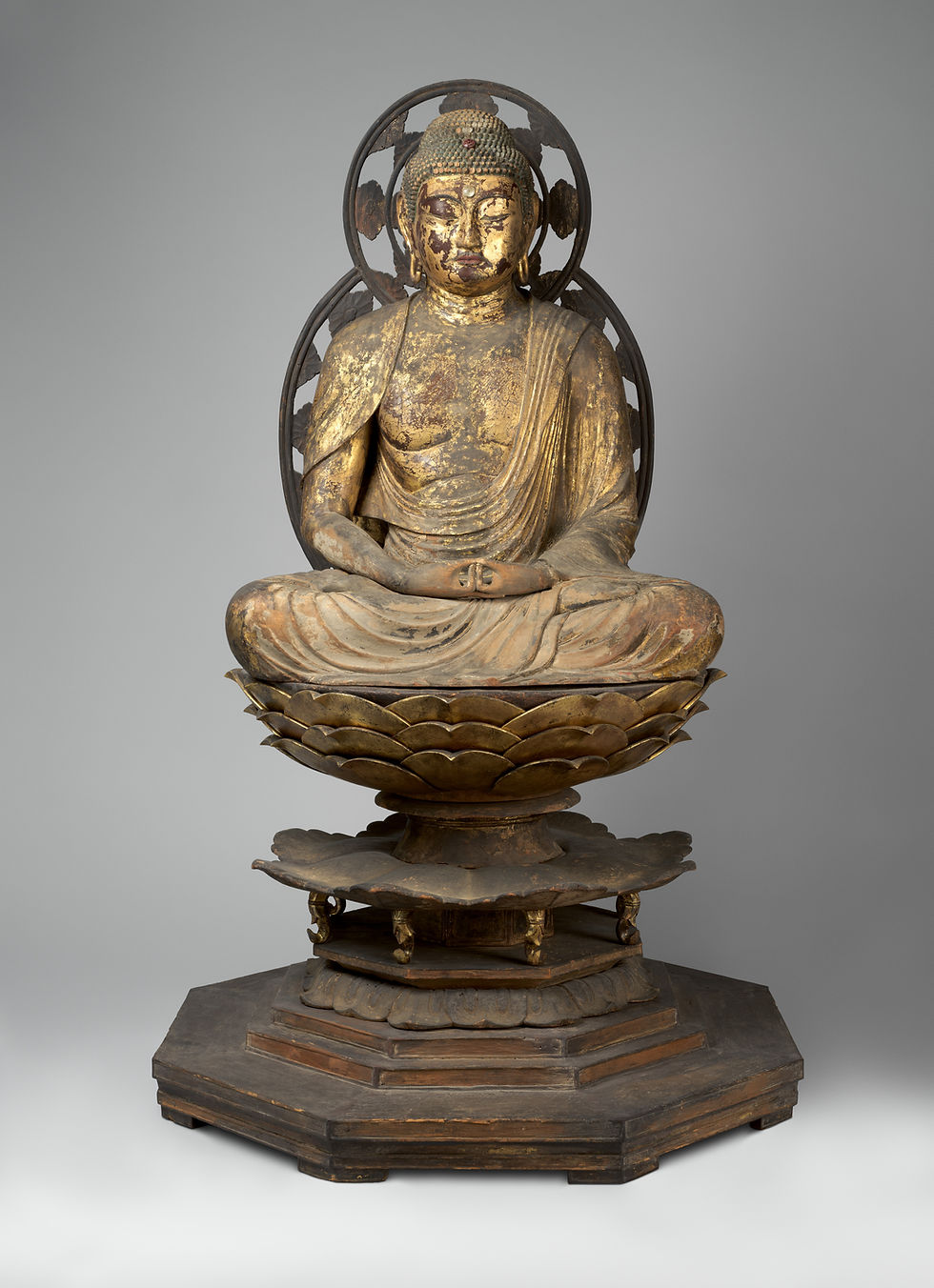
From a curatorial perspective, Japanese antiques provide coherence within this flexibility. A single antique object, such as a time-worn Buddha image, a calligraphic hanging scroll, or a bronze incense burner, establishes gravity and focus. These pieces carry historical weight that anchors the space, preventing it from becoming merely decorative. They invite the viewer into a relationship that is contemplative rather than consumptive.
Material Presence and Contemplative Practice
For many contemporary practitioners, engagement with Buddhist-inspired practice is experiential rather than doctrinal. In such contexts, material presence becomes especially important. Japanese antiques excel in this role because their materials respond subtly to light, sound, and touch. Wood, lacquer, bronze, silk, and paper age visibly and gracefully, reinforcing an awareness of time and impermanence.
Lighting incense, bowing, or simply pausing before an antique object encourages attentiveness. The object does not instruct through text or dogma. Instead, it shapes behavior through atmosphere. In modern homes where digital abstraction dominates daily experience, this tangible presence supports moments of grounding and inward focus.
Ancestral Memory and Ethical Stewardship
While ancestor veneration is deeply rooted in Japanese Buddhism, it resonates broadly across Mahayana and East Asian ritual traditions. In many households, the prayer corner serves as a place to honor parents, grandparents, and lineage, even when religious identity is fluid or plural.
Japanese antiques placed in these spaces often predate the families who now care for them. This temporal distance introduces an ethical dimension. Ownership becomes stewardship. To live with such objects is to accept responsibility for their respectful use and preservation. This approach aligns naturally with Buddhist ethical principles, emphasizing care, humility, and continuity rather than accumulation or display.
Cross-Cultural Resonance and Quiet Authority
The appeal of Japanese religious antiques lies in their restraint. Unlike objects designed to dominate a space visually or symbolically, they operate through understatement and material honesty. This quality allows them to integrate harmoniously into a wide range of domestic interiors, including contemporary minimalist environments, historic residences, and hybrid spaces shaped by multiple cultural traditions.
Their forms evolved within Mahayana Buddhist contexts that emphasized discipline, repetition, and embodied practice rather than spectacle. Bronze incense burners were designed for daily use rather than display. Hanging scrolls functioned as seasonal or contemplative focal points rather than permanent installations. Small-scale devotional sculptures encouraged proximity and intimacy. These functional origins explain why such objects adapt naturally to modern prayer corners, where scale, restraint, and atmosphere are essential.
Forming a Contemporary Prayer Corner or Home Altar
A contemporary prayer corner or home altar benefits from clarity of intention rather than quantity of objects. Historically, Buddhist domestic worship emphasized regularity and continuity over visual abundance. A limited number of carefully chosen elements establishes both focus and dignity.
At minimum, a contemplative space traditionally includes three functional components: a focal presence, a vessel for offering, and an instrument for sound or gesture. In practice, this may take the form of a single devotional image or calligraphic scroll, an incense burner or offering stand, and a bell or striker. Japanese antiques excel in fulfilling these roles because they were crafted for precisely such rhythms of use.
Scale is critical. Antique objects from the Edo, Meiji, and Taishō periods were often produced for domestic settings rather than temple halls. Their proportions correspond well to shelves, alcoves, or small cabinets. This allows the prayer corner to remain integrated within daily living space rather than isolated from it.
Using Antiques with Respect and Continuity
To use an antique in a prayer setting is to enter into an ongoing relationship. Historically, Buddhist ritual objects were not treated as precious in the modern sense of fragility. They were respected precisely because they were used. Each act of care extended their life while allowing them to age naturally.
Lighting incense in an antique burner, for example, mirrors gestures repeated across generations. The hand learns restraint. The pace slows. Ash settles. Over time, these small actions cultivate attentiveness. The object responds not through change, but through constancy.
Practical care supports this continuity. Natural ash, moderate heat, indirect light, and stable humidity preserve both material integrity and visual harmony. Hanging scrolls benefit from periodic rest, allowing the fibers to recover. Cleaning remains gentle and minimal, guided by the understanding that wear is not damage but record.
Ritual Practice and Material Engagement
Regular interaction with antique objects deepens their meaning. Lighting incense, striking a bell, or adjusting a scroll encourages attentiveness and repetition. These gestures cultivate a rhythm that links daily life to contemplative practice.
In Buddhist traditions, material engagement is not separate from spiritual development. The act of care itself becomes practice. Placing an offering, wiping a surface, or bowing before a time-worn image reinforces humility and presence. Over time, the object ceases to function as an external symbol and becomes a participant in lived practice.
Ethical Considerations and Stewardship
Japanese religious antiques carry historical and cultural weight. Their integration into contemporary homes should be guided by discernment. Objects with clear signs of temple origin, inscriptional significance, or ritual consecration require particular sensitivity. In some cases, private domestic use may be appropriate. In others, restraint or consultation with knowledgeable specialists is advisable.
Stewardship implies continuity rather than possession. To live with such objects is to accept responsibility for their transmission. This perspective aligns closely with Buddhist ethical thought, emphasizing impermanence, care, and intergenerational awareness.
Conclusion: Living with Time and Meaning
To live with Japanese antiques in a prayer corner or home Buddhist altar is to accept time as a companion. These objects remind the household that spiritual practice is not an interruption of daily life, but a refinement of it. Morning and evening gestures accumulate quietly, much like the patina on bronze or the softened edge of wood.
In such spaces, the antique ceases to function as an object of observation. It becomes a witness. It listens without judgment, receives offerings without expectation, and endures beyond individual moments of attention. Through this quiet companionship, it teaches a fundamental Buddhist insight: that meaning is sustained through repetition, care, and presence.
When integrated with knowledge and respect, Japanese antiques continue to fulfill their original purpose. They support living practice, offering stillness, depth, and orientation within the ordinary flow of life. In their silence, they invite the practitioner not to escape time, but to live within it more fully.


Comments